A city of stories, not a single literary scene
New Orleans has supplied writers with striking settings: narrow French Quarter streets, crowded downtown routes, lakeside neighborhoods and the nearby coast. But a setting is never the whole story. Writers have also used the city to examine family, race, class, work, desire and belonging. Reading several of them together reveals a place more complicated than the picturesque backdrop familiar from postcards.
George Washington Cable, who was born in New Orleans, set stories and novels in its Creole society. The Grandissimes confronts the legacies of slavery and the city’s racial hierarchy. Kate Chopin, who lived in New Orleans after her marriage, drew on Louisiana life in fiction that often questions the roles available to women. The Awakening moves between Grand Isle and New Orleans; its shifting locations matter to the novel’s sense of freedom and constraint. Neither writer offers a neutral record of the past. Their work is a starting point for asking whose experiences were represented, and whose were left out.
The French Quarter as home and stage
Tennessee Williams lived in the French Quarter, and New Orleans became a defining setting for A Streetcar Named Desire. The play’s streetcars, apartments and close quarters help create its charged atmosphere, but its characters and conflicts should not be treated as a portrait of every resident. For a reader exploring the Quarter, the useful question is not “Where did each scene happen?” so much as “How does the play turn an everyday urban setting into drama?”
William Faulkner also spent time living in the French Quarter early in his career and wrote sketches of New Orleans life. His later reputation rests largely on fiction set in his imagined Mississippi county, making his time here a reminder that a place can shape a writer without becoming that writer’s principal subject. A walk through the Quarter can connect these literary histories, but it is also a lived-in neighborhood. Its residential streets deserve the same care and courtesy as its celebrated public spaces.
Beyond the Quarter: comedy and restless movement
John Kennedy Toole’s A Confederacy of Dunces sends Ignatius J. Reilly through a comic version of New Orleans that includes downtown streets and the French Quarter. Toole, who grew up in the city, makes movement through public spaces part of the novel’s energy. Its exaggerated characters are memorable precisely because the book is a satire, not a guide to what New Orleanians are like.
Walker Percy takes a different approach in The Moviegoer. His protagonist, Binx Bolling, moves between New Orleans neighborhoods, suburban spaces and the routines of ordinary life while searching for something harder to name. Percy lived on the North Shore rather than in the city itself, and that distance helps distinguish his perspective. Read alongside Toole, his novel shows how the same metropolitan landscape can support both unruly comedy and quiet unease. Readers can follow those changes in mood without trying to turn either novel into a literal itinerary.
Voices that widen the literary map
Alice Dunbar Nelson, who was born in New Orleans, wrote fiction attentive to the city’s communities and social boundaries. Her collection The Goodness of St. Rocque and Other Stories invites readers to look beyond the famous landmarks and consider the relationships and assumptions that shape neighborhood life. Like other writing from its period, it is best read with an awareness of the language and social conditions of its time.
Sarah M. Broom’s memoir The Yellow House offers another essential change in perspective. Centered on her family’s home in New Orleans East, it gives sustained attention to a part of the city often missing from visitor itineraries. Memory, housing, family and displacement become inseparable from geography. Reading Broom alongside older New Orleans fiction makes it harder to imagine the city’s literary history as a story confined to the French Quarter—or as one told only through outsiders’ impressions.
How to explore with a book in hand
Choose one work before your visit and mark a few places or types of places that matter to it: a neighborhood, a transit route, a waterfront or a family home. Then notice the distance between the page and the present-day city. Streets and buildings change, and fiction may rearrange geography for its own purposes. If you plan to visit a literary site, bookshop or museum, check its current access and hours directly rather than assuming an older guide is up to date.
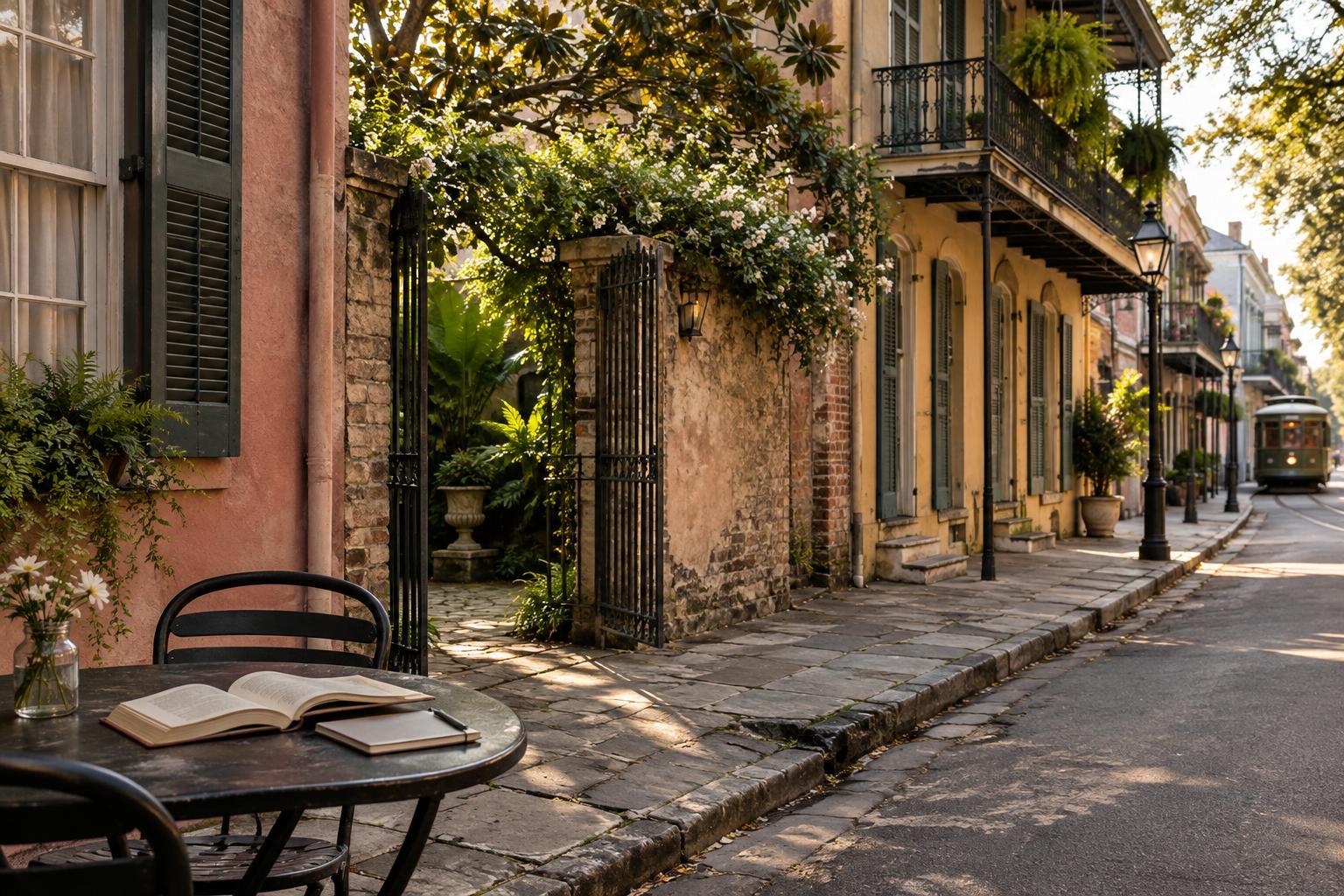
Leave room for reading as well as walking. A public bench or a quiet indoor stop can give you time to compare an author’s description with what you see, without treating residents’ homes as attractions. The richest literary route through New Orleans is not a checklist of famous addresses. It is a way to ask who gets to describe a place, how their vantage point shapes the story, and what another writer might help you notice next.