Know what kind of space you are entering
A gallery visit can mean several different things in New Orleans. A commercial gallery generally presents work for sale and may welcome visitors to browse without an admission charge. An artist-run space, nonprofit arts organization, museum, or temporary exhibition may operate differently. Some offer free entry, while others charge for particular exhibitions, programs, or events. The word “gallery” alone will not tell you what a visit costs.
A free opening reception also does not necessarily mean the exhibition is free at every other time. Likewise, a ticketed talk or performance may take place inside a space that normally welcomes walk-ins. Treat admission as a detail to confirm for the visit you actually want to make, rather than an assumption based on the venue’s name or a photo of its front door.
Check the details before you set out
Start with the venue’s own visitor information. Look for admission prices, suggested donations, reservations, exhibition-specific tickets, and separate charges for talks or workshops. Check the date and hours for the exhibition, not just the building’s usual hours. If a listing is unclear, a short call or message can settle the question: “Is there an admission charge to see this exhibition, and do I need to book?”
This small step is especially useful when you are building an evening around dinner or music. An opening, artist talk, or neighborhood art event may have a different schedule from regular viewing hours. Details can change, so confirm them close to your visit. If you hope to see a particular artist’s work, check that the exhibition is still on view rather than assuming the gallery’s general listing guarantees it.
Make room in your budget without making assumptions
If you want an art-focused afternoon with little or no admission cost, you can look for commercial galleries that welcome browsers and for spaces that explicitly list free entry. Leave some flexibility: a paid exhibition that interests you might be worth choosing over several quick stops. Suggested donations deserve attention, too. If a space explains that donations help support its work, give what you comfortably can rather than treating the suggestion as invisible.
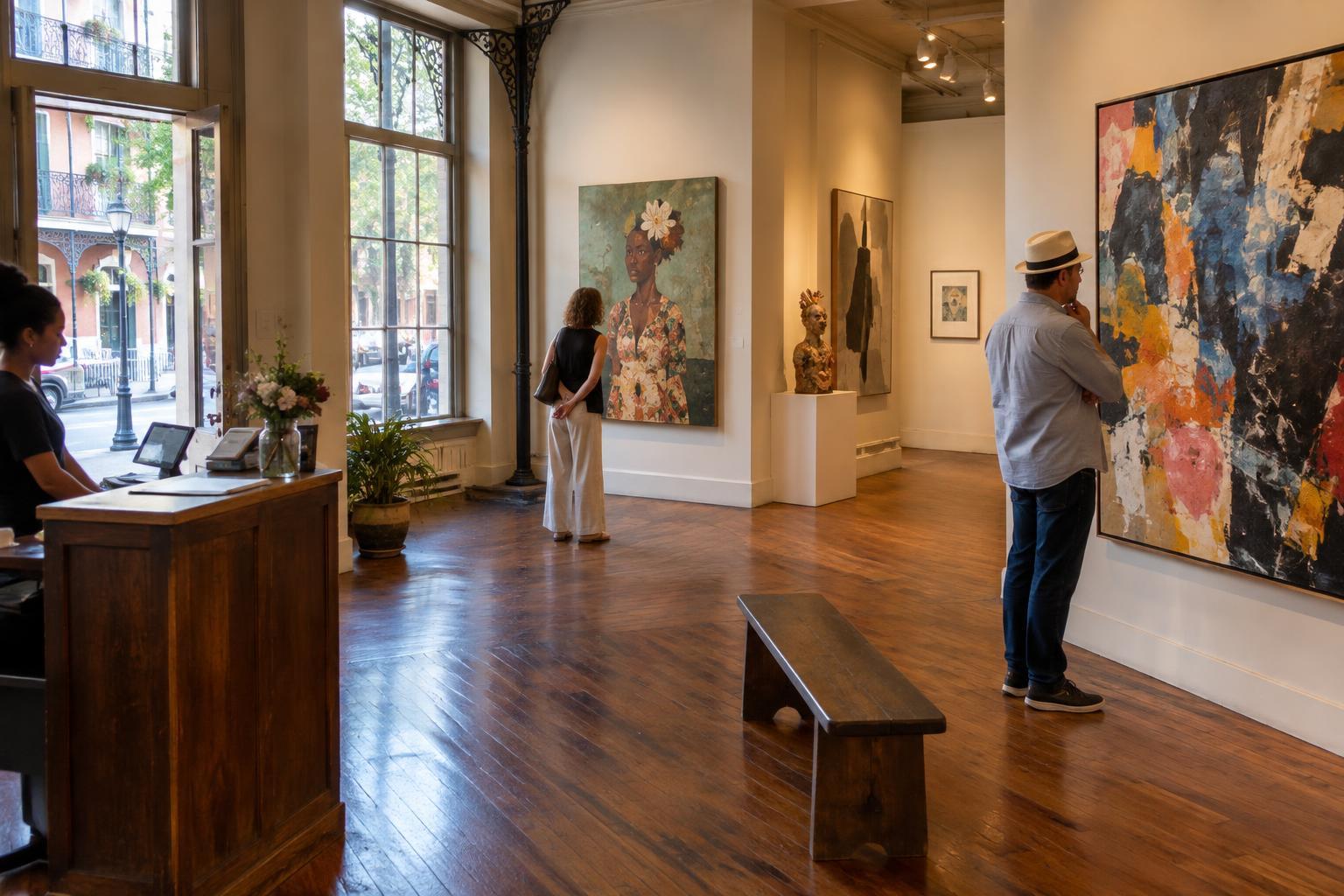
You do not need to buy art to enter a commercial gallery unless the venue says otherwise. Looking closely, asking a thoughtful question when staff are available, and taking a card for an artist whose work stays with you are all reasonable ways to engage. If a piece is for sale and you are curious, it is fine to ask about the price. If you are not shopping, there is no need to pretend that you are.
Be a considerate guest around the art
Pause near the entrance for any posted guidance on photography, bags, food, and touching the work. Photography rules can differ from one exhibition to another, and permission to photograph a room does not automatically mean flash or close-up images are welcome. Give other visitors room to look, keep drinks away from artwork, and supervise children around fragile pieces. These habits matter in small galleries, where the work and the people caring for it may be close at hand.
An opening reception can feel social, but it is still an opportunity to encounter someone’s work. Read labels where they are provided, avoid blocking a piece for a long conversation, and follow the artist’s or staff member’s lead if you want to ask questions. Sharing a photo online is not a substitute for credit: if you post one with permission, identify the artist when that information is available.
Plan a route that leaves time to look
New Orleans rewards a slower gallery itinerary. Choose a few stops that interest you rather than trying to cover every space in one outing. Allow time for travel, for a conversation that develops naturally, and for an exhibition that asks for more than a glance. If walking distance, seating, step-free access, or a quiet viewing time matters to you, ask the venue directly; access can vary even among nearby spaces.
You can pair a gallery visit with a meal or a music outing, but let each have its own time. A rushed stop just before closing rarely gives you the same experience as an unhurried look. With admission and hours checked in advance, you can arrive knowing what to expect—and remain open to finding work you did not know to seek out.