Understand what you are witnessing
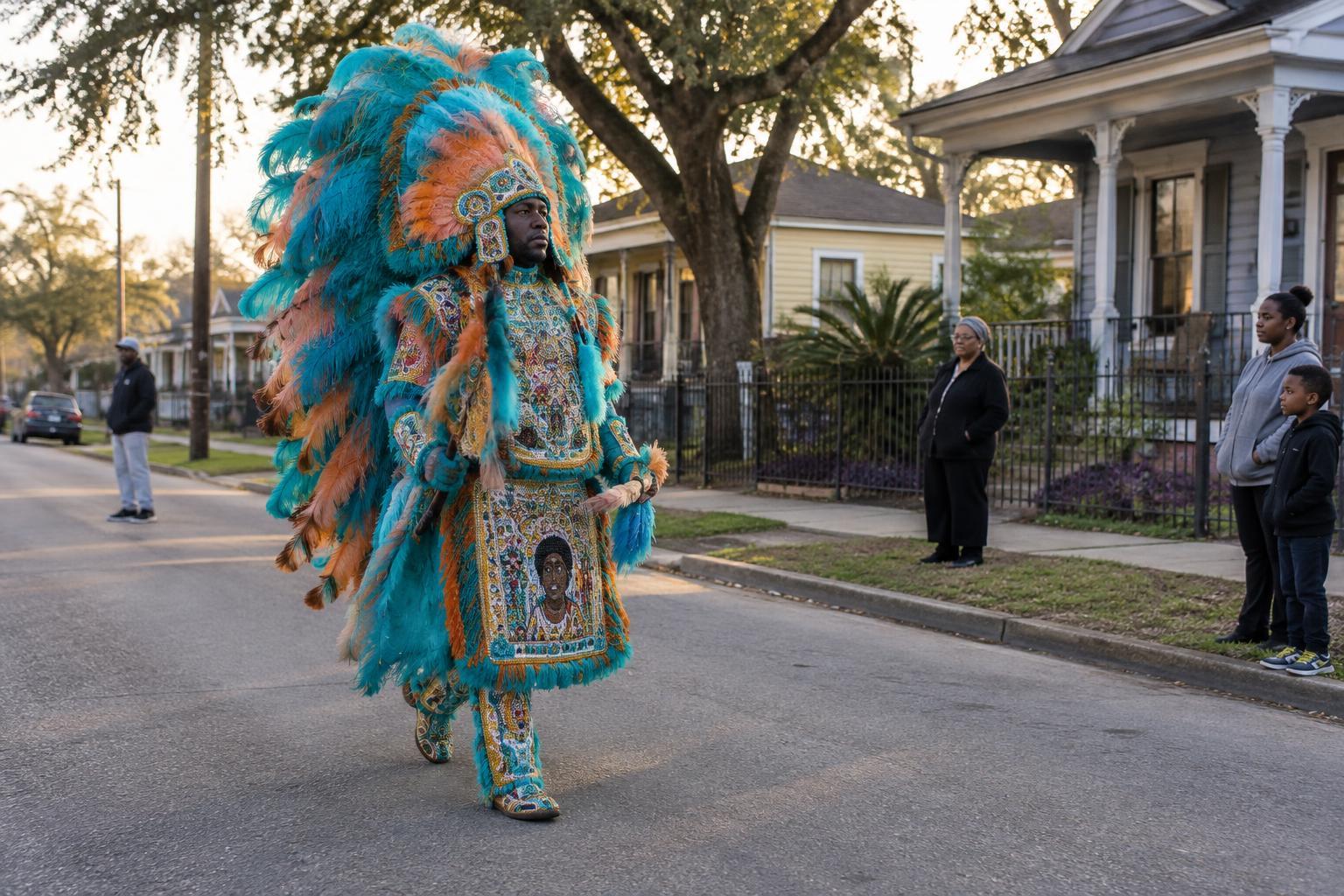
A Mardi Gras Indian public appearance can be visually dazzling, but it is more than a chance to see an elaborate suit. New Orleans’s Black masking Indian traditions bring together neighborhood relationships, music, craftsmanship and generations of knowledge. Participants may use titles such as Big Chief or Spy Boy, and groups have their own identities and ways of doing things. Approaching an appearance as a community occasion, rather than a show put on for visitors, is a useful place to start.
You may also hear the term Black Masking Indians. Terminology and understandings of the tradition can vary among participants, so follow the language people use for themselves. Avoid treating every group as interchangeable or making assumptions about a person’s identity from a suit. You do not need to explain the tradition to others while you watch; listening and paying attention are often the more respectful choices.
Find a public moment without expecting a fixed itinerary
Maskers may appear around Mardi Gras and at other community gatherings, including events often called Super Sundays. An announced public event can be a good starting point for a visitor, but plans, routes and timing may change. Before heading out, check information shared by event organizers or participating groups, and allow for uncertainty. Do not assume a group will pass a particular corner at a particular hour.
Public appearances are not invitations to follow people into private spaces. If a gathering shifts toward a home, preparation area or other place that does not seem open to spectators, stay back. The same applies to a quiet moment when participants are tending to their suits, speaking with family or simply taking a break.
Give the procession and its neighbors room
On a sidewalk or along a street, keep a clear path for maskers, musicians and the people moving with them. Watch where you stand: a good camera angle is not worth blocking a doorway, stepping into a procession or forcing someone to walk around you. Be especially mindful around children and elders, and follow any directions from people helping manage the gathering.
These appearances take place in lived-in neighborhoods. Avoid leaning on fences, entering yards or treating a porch as a viewing platform. Keep noise, litter and other disruptions to a minimum. If you arrive early, wait without occupying someone’s steps or driveway. When you leave, take your belongings and trash with you. Small choices like these help keep the focus on the people whose community has brought everyone together.
Photograph with care, not entitlement
A public setting does not mean every moment is yours to record. If you want a close portrait, ask first when there is a natural pause, and accept a refusal without pressing. Do not stop someone who is moving with a group to arrange a shot. Never touch a suit, feathers, beadwork or other regalia for a photograph; the work can be delicate, personal and time-consuming to make.
For wider scenes, be aware of what your camera is doing to the space around you. Keep flash and equipment from interfering with participants or other onlookers, and avoid pushing forward with a phone held in someone’s face. Before posting, consider whether an image shows a moment the person would reasonably want shared. If you plan to use images commercially, seek clear permission rather than assuming that attendance grants it.
Let the encounter be more than a checklist stop
You might hear singing, percussion or exchanges between groups; you might also spend time waiting and see only a brief appearance. Resist asking participants to repeat a moment or pose as though they owe you a complete experience. Give them room to set the pace, and listen when local attendees signal that you should move or make space.
If you want to learn more afterward, look for public talks, exhibits or programs in which practitioners choose how to present their work. When a public event shares ways to support its organizers or participating community groups, consider those options. The best visitor experience is not necessarily the closest view or the largest collection of photos. It is one in which you leave with a better appreciation of the artistry while allowing the occasion to remain in the hands of the people who sustain it.