A gathering place under constraint
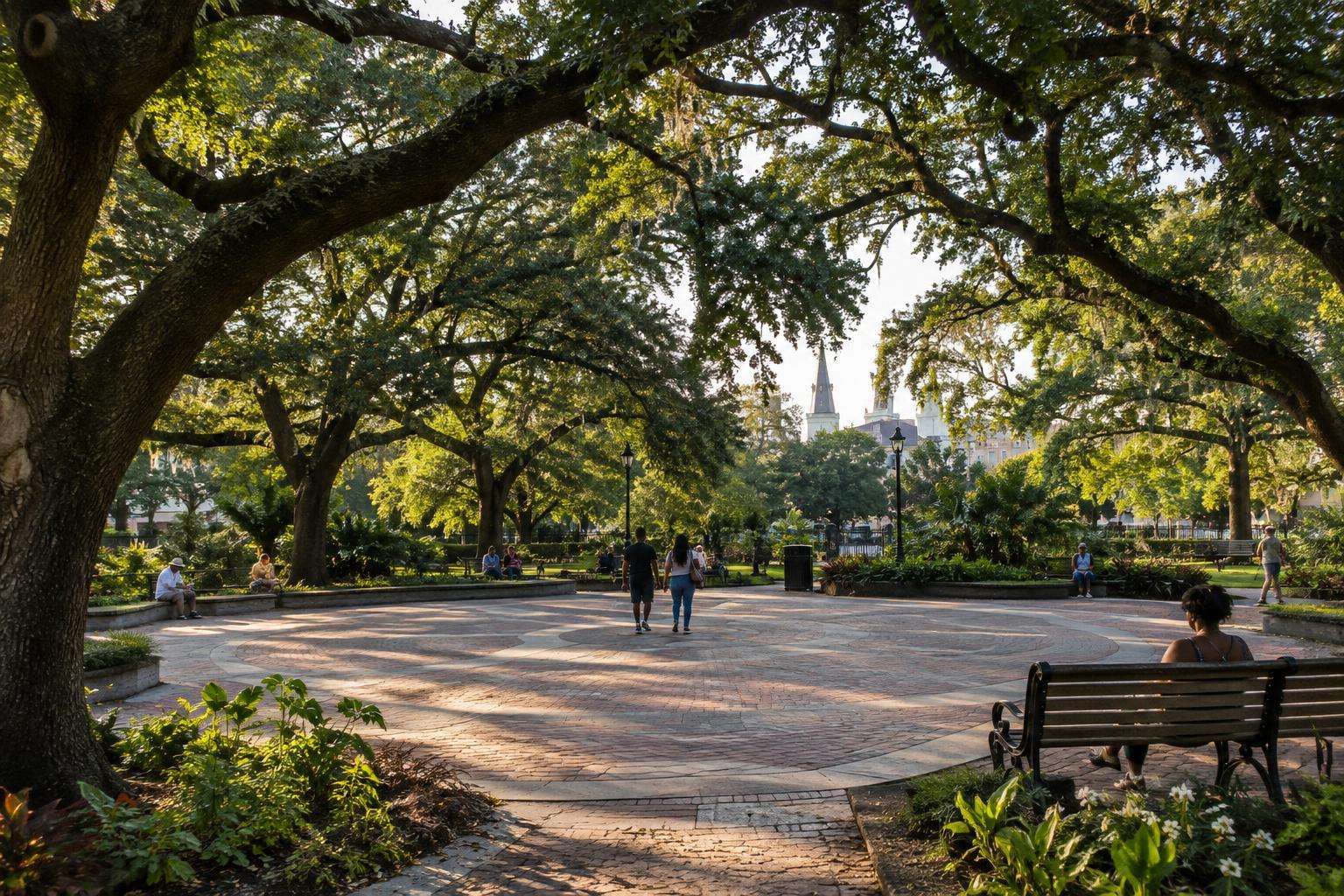
Congo Square, on the edge of Tremé in what is now Louis Armstrong Park, is often introduced to visitors as a birthplace of jazz. That phrase points to an important connection, but it can make a complicated place sound like the setting for one decisive musical event. Congo Square’s history begins with people gathering under the conditions of slavery, finding ways to meet, trade and practice culture within limits imposed by others.
In the colonial and early American periods, enslaved people in New Orleans gathered in this area, particularly on Sundays. Accounts describe music, dancing, drumming and commerce. The gatherings were not simply leisure in the modern sense: participants were living with coercion, and the space available to them depended on rules and enforcement they did not control. Holding those realities together matters. Describing the gatherings as expressions of creativity should not obscure the circumstances in which they took place.
What people brought, exchanged and made
New Orleans was shaped by people with different African, Caribbean and European backgrounds, as well as by the city’s particular history of enslavement, migration and trade. Congo Square was one place where those histories met in public. Music and dance there did not belong to a single, uniform tradition. Participants brought practices with their own meanings, then adapted them in contact with other people and with life in New Orleans.
It is tempting to listen for a straight line from a drumbeat in the square to a familiar jazz rhythm. Cultural change rarely works so neatly. Sounds, movements and ways of gathering can travel through families, neighborhoods, celebrations and working lives, changing along the way. Congo Square helps explain why public performance and shared rhythm have such deep significance in New Orleans. It does not, by itself, explain every musician, style or social setting that later contributed to jazz.
More than a music-history landmark
The square’s historical importance also includes the ordinary human purposes of gathering. People could encounter others, exchange goods, maintain relationships and take part in practices that connected them to communities beyond the square. Those activities are harder to fit into a short plaque or a quick tour stop than a story about a musical genre, but they help make the site understandable as a lived place.
The surroundings matter, too. Tremé is a neighborhood with its own long cultural life, not merely a backdrop for a landmark. Reading Congo Square only as a distant chapter in music history can separate it from the people and communities who have continued to give the area meaning. A more useful question for visitors is not just “What began here?” but “Who has gathered here, under what conditions, and what has this place meant to them?”
How an origin story can flatten history
Calling Congo Square a birthplace of jazz can be a helpful invitation to learn more. Taken literally, though, it risks suggesting that jazz appeared in one location at one moment. Jazz developed over time through the work of many people and through several kinds of music-making in New Orleans and beyond. No single site can carry that entire history.
An origin story can also shift attention away from the people whose names and individual experiences are less often preserved. It may celebrate resilience without spending enough time on the restrictions that made resilience necessary. A fuller account leaves room for both artistic achievement and loss, for cultural continuity and change. It treats the gatherings at Congo Square as significant in their own right, not only because of what later generations would hear in them.
Visiting with attention
If you visit Congo Square, give yourself time to look beyond the familiar summary. Notice its relationship to Tremé and to the larger park. Read on-site interpretation where available, and consider how different accounts describe the people who gathered there: as active participants in community life, not anonymous precursors to a later genre. If a tour, performance or program is part of your plans, check its current details directly rather than assuming a regular schedule.
Most of all, resist the urge to treat the square as a place where a finished musical tradition can be located and photographed. Its value lies partly in the questions it asks about public space, cultural survival and who gets to tell a city’s story. Congo Square is connected to the music that draws many visitors to New Orleans, but it is also a place to think about the lives and relationships behind that music.