Start with the artist, not the label
“Folk art” can describe work connected to a community’s shared practices, while “self-taught art” often refers to work made outside formal art-school training. Neither label tells you everything about an artist. People learn from relatives, neighbors, jobs, faith communities and years of practice. An artist may also have formal training in one field and learn another through community experience.
In New Orleans, it is tempting to group every colorful sign, decorated yard or parade costume under one appealing label. That can obscure important differences. A painted storefront sign may be a commissioned piece of skilled commercial work. A porch display may be personal rather than intended for an audience. Beadwork made for a Black Masking tradition belongs to a living cultural practice with its own makers, histories and expectations. Begin by asking who made something, what it was made for and how its maker describes it.
Look beyond gallery walls
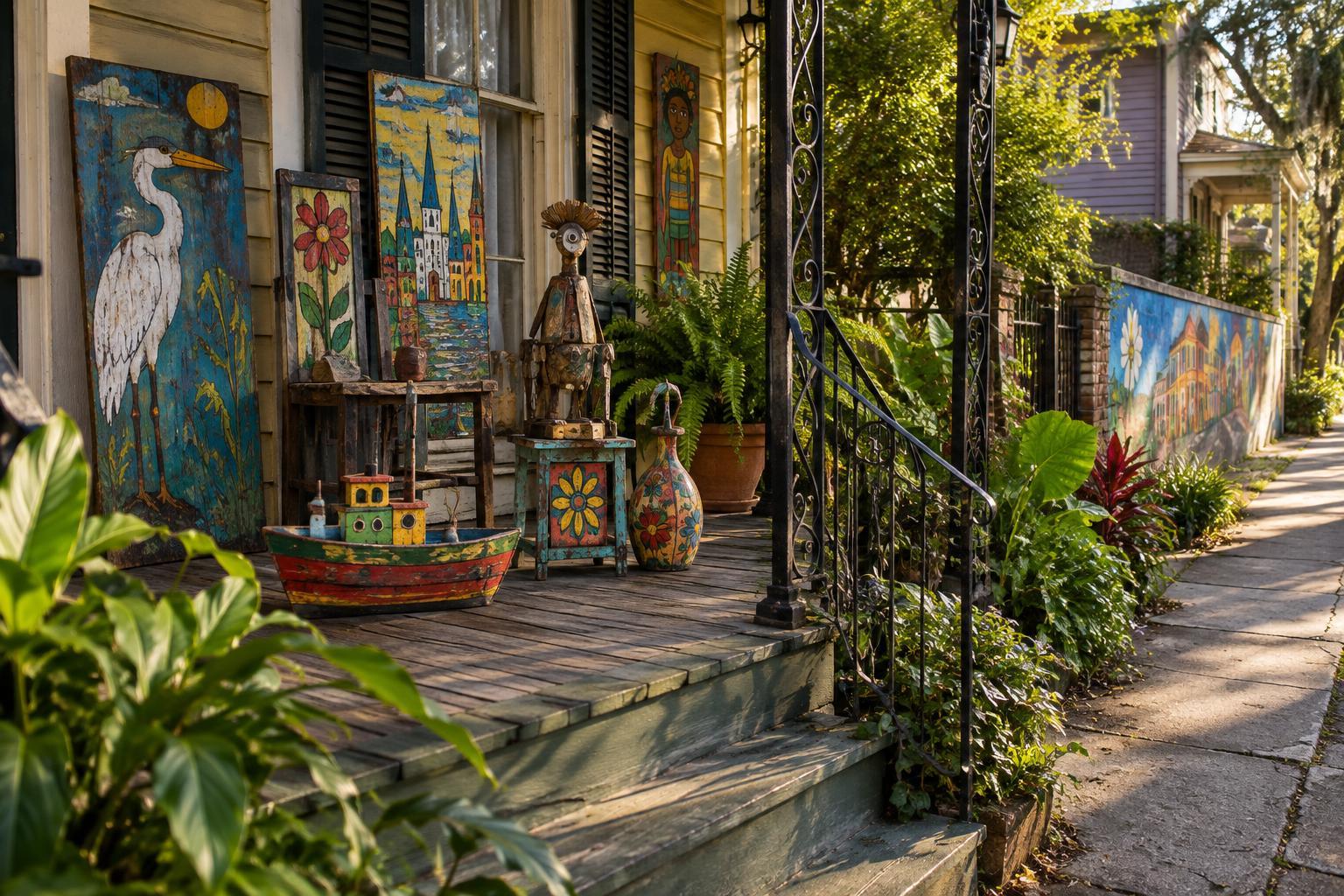
Galleries and museums offer a useful introduction because labels may provide an artist’s name, materials and context. Street-level looking can teach you different things. Hand-painted signs, murals, decorated fences and inventive uses of found materials show how art can shape the everyday appearance of a neighborhood. These examples are not interchangeable, and not all are folk art or self-taught art.
As you walk, pay attention to materials and setting. Has an artist reused wood or metal for texture, painted a message meant to be read from the sidewalk, or built a display that changes over time? Look for signatures and explanatory text before guessing at a meaning. A work’s location matters too: a piece made for a home, business or community gathering may have a purpose beyond being admired by visitors.
Understand the connection to living traditions
New Orleans is known for traditions in which visual making, music and gathering meet. The elaborate suits created within Black Masking Indian communities, for example, involve sustained design and handwork. But it is reductive to treat a suit as simply a striking object, or to assume every maker fits the category “self-taught.” The work has meaning within relationships and practices that a brief encounter cannot fully explain.
The same care applies elsewhere. A parade banner, a neighborhood mural and an artist’s assemblage may all be visually compelling, yet they arise from different decisions and communities. Learning a tradition’s name is a starting point, not permission to speak for its participants. Seek out artists’ own accounts when they are available, and allow room for people to describe their work in terms other than the ones you brought with you.
Be a considerate visitor
Publicly visible art invites looking, but visibility does not make a home or a person available for inspection. Stay on public paths, do not enter yards to get a closer photograph, and avoid blocking a doorway or business. If an artist or participant is present, ask before taking a close-up portrait or photographing work in a setting where photography may be unwelcome. Accept a no without pressing for an explanation.
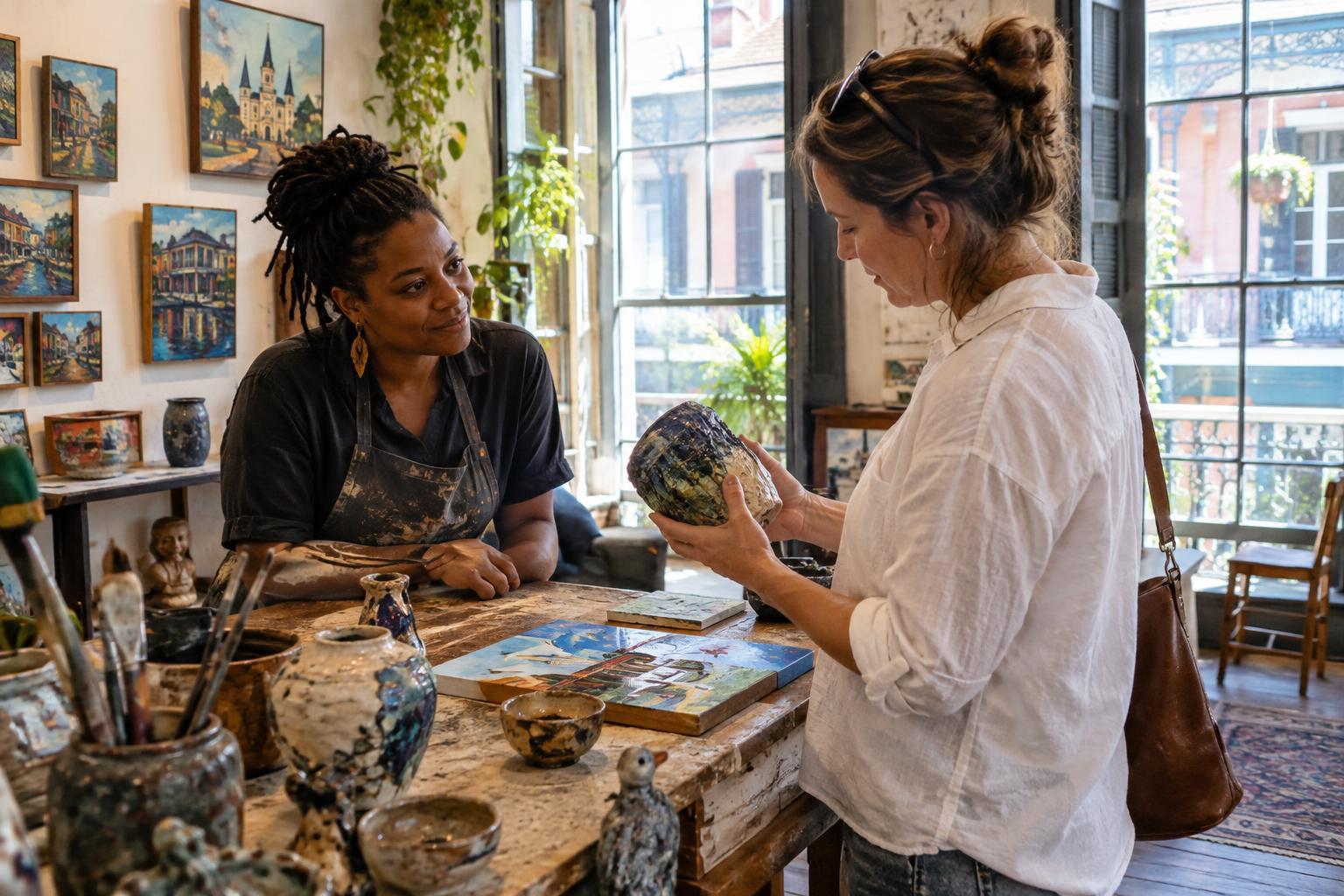
When viewing work in a shop or gallery, read the information provided and ask specific, open questions: Who made this? What materials did they use? Is the artist’s own description available? Questions like these are more useful than asking someone to stand in for all New Orleans artists. If you plan to visit an exhibition or public event, check its current details directly rather than relying on an old listing.
Take something meaningful home
Buying directly from an artist, or from a seller who can identify and credit the maker, can make a souvenir more meaningful. Ask whether a piece is original, an authorized reproduction or a mass-produced item inspired by a local style. Price alone will not answer that question. If a work is beyond your budget, a smaller piece or print offered by the artist may be a better choice than an imitation with no clear connection to its maker.
You do not have to buy anything to appreciate the art. Take time to read a label, remember an artist’s name or learn why a work belongs where it does. New Orleans rewards that slower approach: what first looks like decoration can become an invitation to understand how people express identity, skill, humor and belonging in the places they share.