First, know why the names get confusing
The Warehouse District and the Central Business District, usually shortened to CBD, are neighboring parts of downtown New Orleans. The distinction is useful, but it is not a line every map, hotel, or resident draws in exactly the same place. Some people treat the Warehouse District as a portion of the broader CBD; others use the two names to describe different experiences within downtown.
For a visitor, the easiest approach is to treat the names as clues rather than precise boundaries. “CBD” often points to the downtown office-and-hotel core, while “Warehouse District” suggests the converted industrial blocks associated with galleries, museums, restaurants, and residential buildings. A listing’s cross streets will tell you more about its location than its neighborhood label alone.
Use the streets to get oriented
Canal Street is a helpful northern reference point: cross it from the French Quarter and you enter the downtown area commonly called the CBD. Poydras Street is another useful landmark, running through a stretch of large office buildings and hotels toward the river. The grid can feel different from the French Quarter’s, so check an address rather than assuming that two places described as “downtown” are a short stroll apart.
Farther upriver, around Julia Street and the blocks toward the river, the Warehouse District identity becomes more apparent. Former commercial buildings, galleries, and cultural destinations sit among newer developments. The area is also often called the Arts District. Near its edges, signs and listings may use “CBD,” “Warehouse District,” or “Arts District” for places only a few blocks apart. That overlap is normal, not necessarily a mistake.
Notice what changes at street level
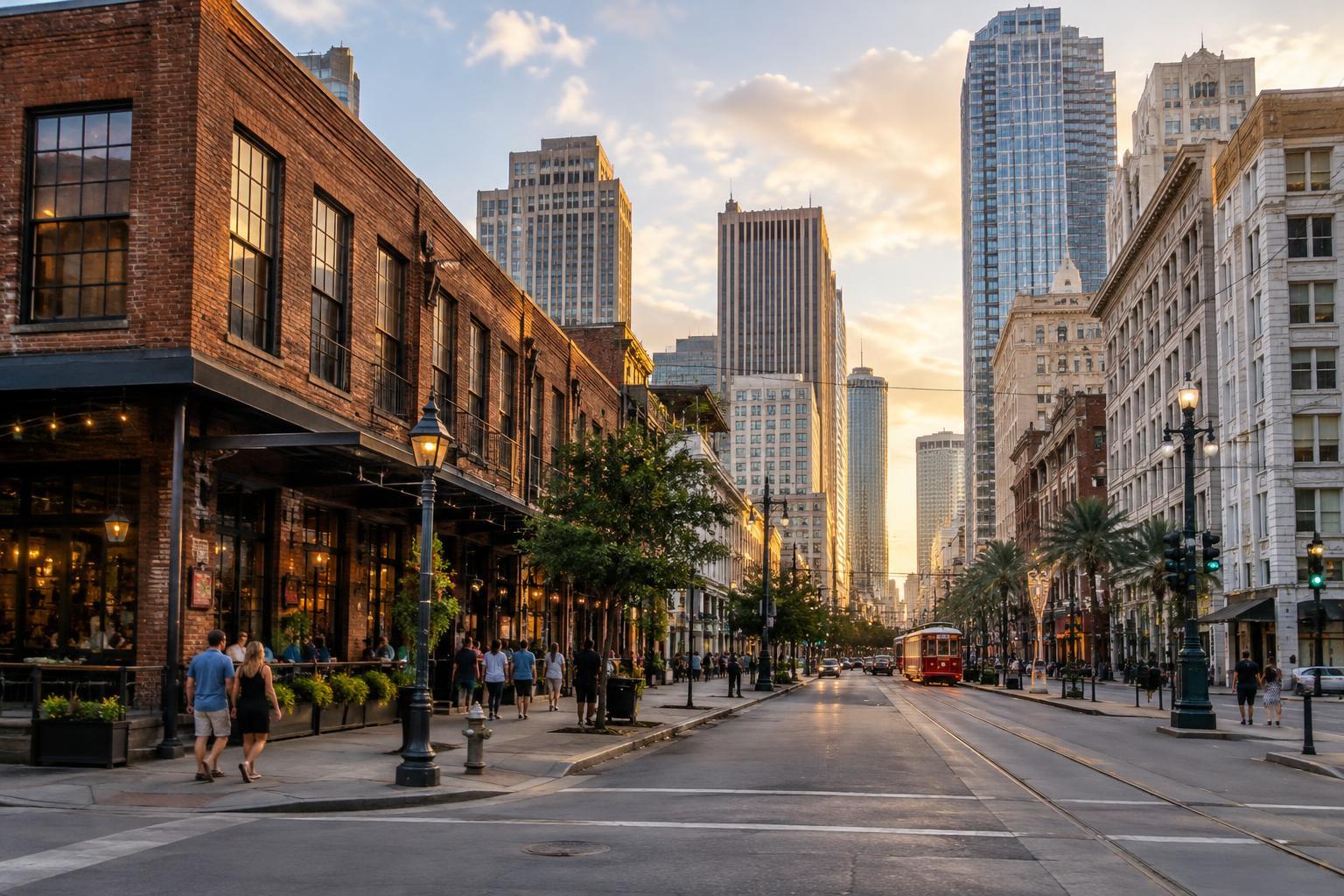
In the CBD core, expect a mix of office towers, major hotels, parking structures, and busy corridors. Its character can shift from block to block: a street that feels workday-oriented may be close to a restaurant, theater, or lively hotel lobby. The CBD is not simply a business district that closes at night, but its larger buildings and broad streets give parts of it a different feel from nearby historic neighborhoods.
In the Warehouse District, the older industrial building stock is a stronger visual cue. Look for substantial brick facades, wide windows, and spaces adapted for new uses. Cultural stops and dining options are part of the appeal, though they are scattered rather than lined up on every block. Neither neighborhood is uniform. Walking a few minutes can take you from an active stretch to a quieter one, especially outside the busiest visitor corridors.
Choose a base by your plans, not the label
If you want straightforward access to downtown hotels, office destinations, or transit connections, a CBD address may suit you. If your plans center on museums, galleries, and meals around the Julia Street area, a Warehouse District address may put more of those stops within an easy walk. Both can work well for a visit that also includes the French Quarter; the exact hotel location matters more than the neighborhood name on a booking page.
Before booking, plot two or three places you expect to visit and look at the walking route, not just the distance. Check which side of a wide street your destination is on, whether your route includes long blocks, and how you expect to get back after dinner. If you are planning around a specific museum, performance, or restaurant, confirm its location and hours directly; names and schedules can change.
Make the most of the overlap
You do not need to decide where one neighborhood ends before exploring either one. A simple outing might start near Canal Street, pass through the CBD’s busier corridors, and continue toward the galleries and reused warehouses around Julia Street. Going on foot lets you see the change in scale and architecture better than a neighborhood map can explain it.
For an evening out, plan around a particular destination rather than expecting every block to have the same level of activity. Leave time for the walk between stops, use normal city awareness, and choose a ride if a route feels uncomfortable or is farther than expected. The most useful distinction is practical: the CBD describes a broad downtown hub, while the Warehouse District points you toward its arts-and-industrial side. Once you know that, the blurred border is much easier to navigate.