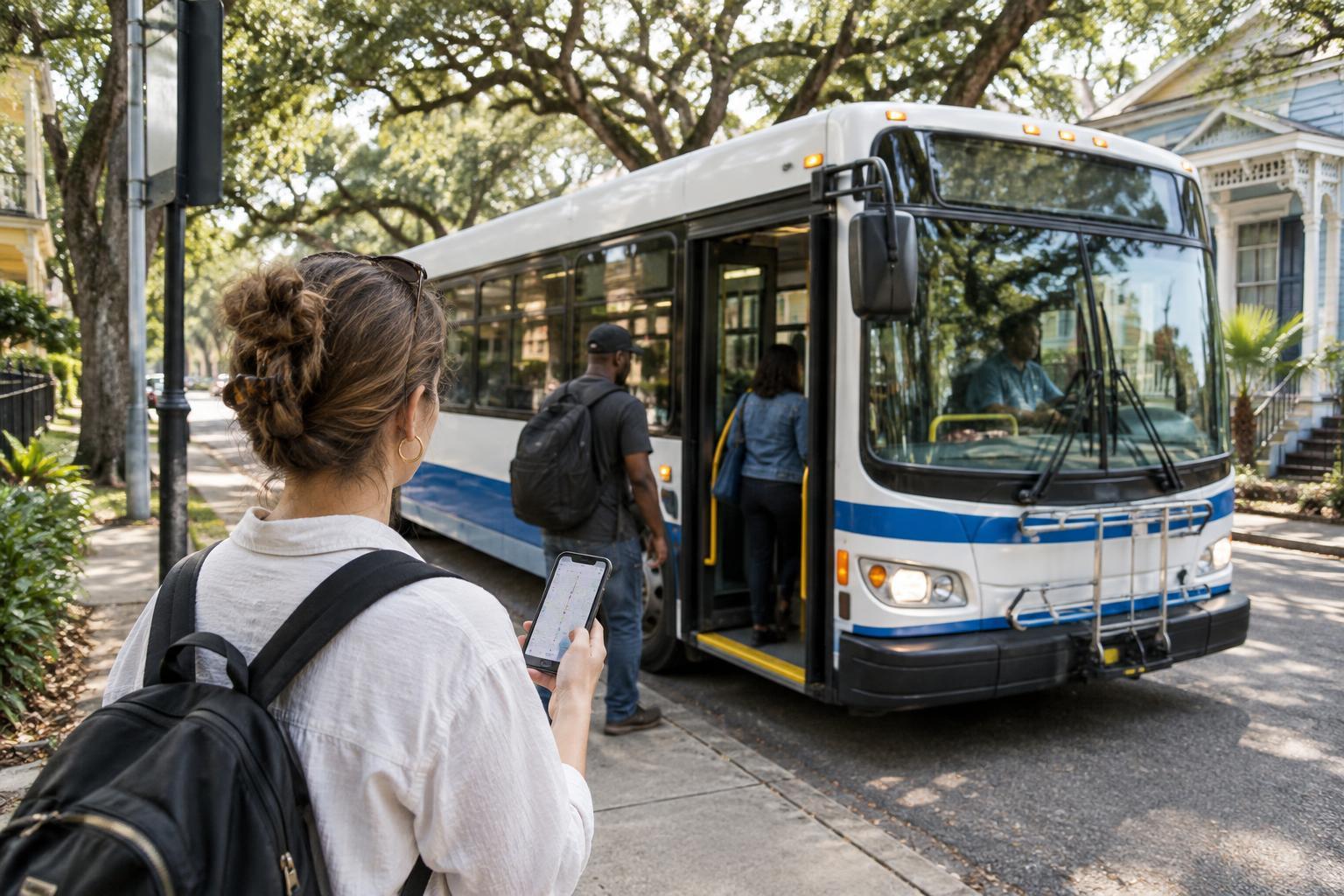
Start with the trip, not the route number
New Orleans visitors often hear more about streetcars than buses, but buses can be useful when a destination is away from a streetcar line. Start by identifying your exact destination, not just its neighborhood. A restaurant, museum or music venue may be a comfortable walk from one stop and an awkward walk from another, especially in heat or rain.
Enter both addresses into a trip planner and compare the suggested transit journeys. Look at the entire trip: the walk to the first stop, the direction of travel, any transfer, and the final walk. A route that appears direct on a map may take longer than one with a well-timed connection. Conversely, a journey with fewer transfers may be easier if you are carrying bags or heading back after an evening out.
The New Orleans Regional Transit Authority, often called the RTA, is the place to check official route maps, schedules, fares and service notices. A general map app can help you compare options, but confirm important details with the RTA before relying on a trip, particularly if it depends on a specific connection.
Read the route in both directions
A bus route has two directions, and the stop for your return trip may be across the street, around a corner or somewhere else nearby. Check the destination shown for the bus you intend to board rather than relying on its route number alone. Before leaving your lodging, save or note the stop you need for the journey back.
When reviewing a route, distinguish between a line on the map and the trips that actually operate when you need them. Check your intended day and time, then allow a little room for traffic and delays. If a planner offers several departure choices, compare them rather than assuming buses arrive at even intervals throughout the day. For an appointment, ticketed performance or airport connection, build in a backup plan.
Make transfers part of the plan
A transfer means changing from one vehicle to another. Before you set out, find the transfer stop for each leg and check whether you need to cross a street or walk to a different stop. It is also worth checking the next departure after your planned connection. That tells you how much a missed transfer might affect your trip.
Do not assume that paying for one ride automatically covers every connecting ride, or that a ticket valid on one service works the same way on another. Fare products, transfer rules and payment methods can change. Check the RTA’s current fare information for the option you plan to use, including any time limit or validation step. If you are buying a pass, consider whether it fits your actual itinerary rather than purchasing one simply because you expect to ride often.
Keep the transfer plan simple when possible. A single connection at a stop you can identify clearly may be preferable to a journey with multiple tight connections, even if the estimated arrival times look similar.
Use live tools without depending on them completely
The RTA’s official trip-planning information and service alerts are useful starting points. Map apps may also display nearby stops, walking directions and predicted arrivals. Predictions are estimates, however, and a phone can lose signal or battery just when you need the return route. Save the route number, boarding stop and destination address somewhere you can consult offline.
Check for service notices shortly before departure, especially if your route passes through an area with an event, construction or a temporary street closure. At the stop, confirm its posted information and watch the destination display on the arriving bus. If the vehicle’s destination does not match your plan, ask the operator whether it serves your stop before boarding. Keep questions brief while people are getting on.
Plan for the walk and the ride home
A transit itinerary includes time outside the bus. New Orleans weather can make a short walk feel longer, and not every stop offers shelter. Bring water as appropriate, wear shoes suited to uneven sidewalks and leave enough time to find the correct stop. If step-free access or another accommodation matters to your trip, consult current RTA accessibility information for the vehicles and stops you expect to use.
Plan your return before you go out. Look up the last useful departure for your route, check whether the return stop differs from your arrival stop, and identify an alternative if the timing does not work. This is particularly helpful after dinner or a show, when a route that served you well earlier may be less convenient. With those basics settled, buses become another practical way to explore the city rather than a puzzle to solve at the curb.